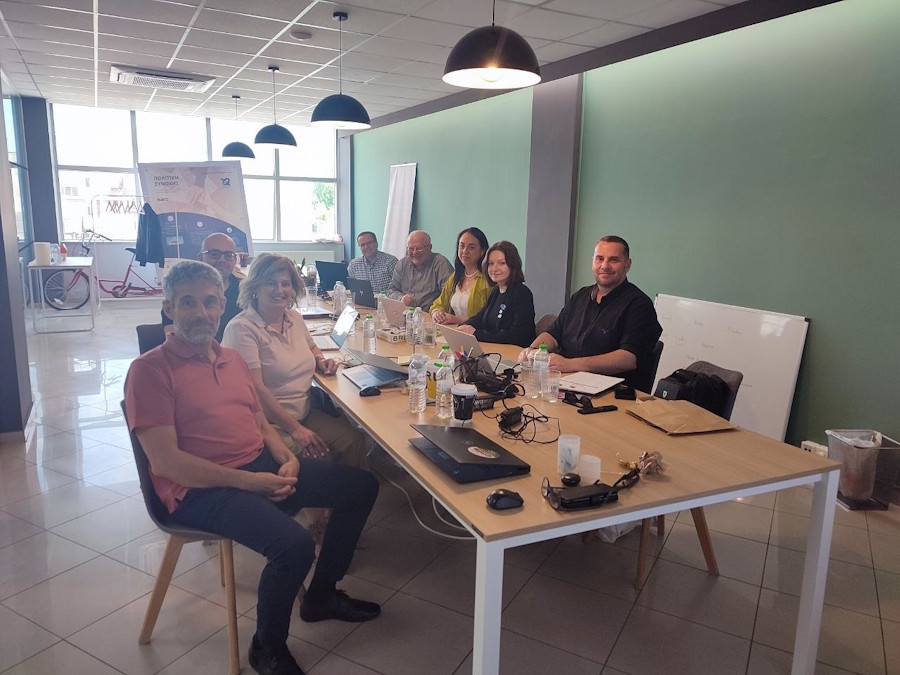
The DAISSy Research Group of the Hellenic Open University (HOU), proudly announces the publication of the core Methodology of the "4C-FUTURE" European project, which was implemented following months of intensive research, collaboration, and classroom testing in school environments across four European countries (Bulgaria, Greece, Portugal and Czech Republic). DAISSy-HOU being the technical project partner, contributed decisively to the formulation of this innovative pedagogical approach, which bridges theory and practice. This comprehensive scientific document lies at the heart of all project activities and is now ready to support educators in integrating the "4Cs" (Critical Thinking, Collaboration, Communication, Creativity) skills into daily school reality.
It is a fact, that students have been growing up in a modern world that demands more than simple rote memorization of knowledge. Employers, researchers, and educators worldwide agree that four core competences are essential for thriving in the 21st century, namely Critical Thinking, Collaboration, Communication and Creativity. These skills cannot be easily taught through traditional methods. They require active, experiential opportunities where students act, reflect, and develop. This is precisely what the 4C-FUTURE Methodology enables for every teacher and every class, regardless of the subject area or their prior experience on games and gamification.
Specifically, the 4C-FUTURE Methodology is built upon three interconnected pillars:
- Experiential Learning: Placing students at the center of learning through action, reflection, and making sense of real-world experiences.
- Gamification: Utilizing educational missions, storylines/narratives, and feedback loops to maintaining students' interest and motivation.
- Game-based Learning: Applying the "4Cs" in action, through role-playing, simulations, escape rooms, and board games, within safe and playful environments for students.
Cultivating digital and media literacy is strongly integrated throughout this entire process. In most approaches, students simply play games. 4C-FUTURE goes a step further: students and educators are guided to design their own educational games. This transforms learning from a passive experience into an act of creation.
It is noteworthy, that the methodology is designed primarily for educators working with students aged 13–17, regardless the topic and the experience background on using game-based learning. The Methodology document offers support at every level, since it includes theoretical foundation for those who need it and practical tools for those who want to jump straight into action. The short version of the 4C-FUTURE Methodology is available for discovering the topics covered by the entire document.
The Methodology forms the basis for the upcoming stages of implementation of the 4C-FUTURE project, as the next deliverables include specialized training for educators, a collection of ready-made educational games, and digital resources.
The analysis of the whole Methodology is available HERE.
The 4C-FUTURE is a three-year project (1.12.2024–30.11.2027), funded by the EU ERASMUS+ Lump Sum Grant program and coordinated by the “EPMA” organization (Czech Republic), with the participation of five (5) partners from four (4) EU Member States (Bulgaria, Greece, Portugal and Czech Republic). The DAISSy Research Group of the Hellenic Open University plays an active role in the implementation of all 4C-FUTURE actions in Greece, strengthening cooperation with appropriate relevant bodies, through the networking it maintains, at national and European level, so as to ensure the multiple exploitation of the project results and its positive impact.

The European Commission support for the production of this publication does not constitute endorsement of the contents which reflects the views only of the authors, and the Commission cannot be held responsible for any use which may be made of the information contained therein.