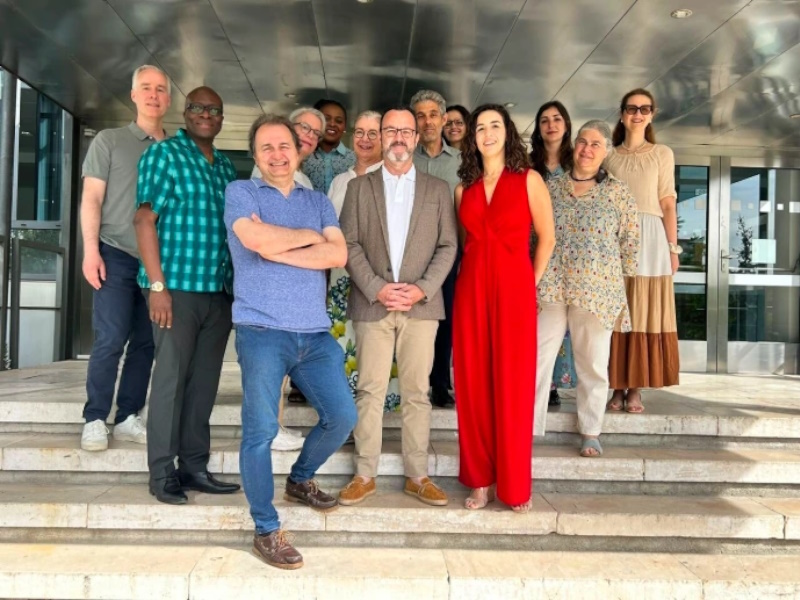
The DAISSy Research Group of the Hellenic Open University (HOU), the Greek partner in the “Building a European Reference Framework for Inclusion, Diversity and Equity in Higher Education (IncluDE)” European project, participated in the Transnational Partners’ Meeting (TPM), held on 2–3 June 2026 in Madrid (Spain). The meeting was hosted by the Faculty of Education of the Universidad Nacional de Educación a Distancia (UNED), the Spanish project partner.
The main aim of the IncluDE project is to support Higher Education Institutions (HEIs) and lifelong learning providers in implementing the principles of Equity, Diversity and Inclusion (EDI) through the development of a range of tools: the Compendium of Principles and Recommendations, the Inclusion Reference Framework, the Inclusivity Evaluation Instrument, the Inclusion Observatory and Resources Portal, and the Continuous Professional Development Programme for staff. The DAISSy Research Group is involved in all Work Packages and is responsible for validating the Integrated Inclusive Higher Education Resources Portal and AI Assistant (WP4).
All partners in the IncluDE consortium participated in the TPM to review progress and coordinate the next steps of the project. DAISSy-HOU was represented by Achilles Kameas, Professor at HOU and Director of the Research Group. He actively participated in all sessions, contributing to discussions on topics under the responsibility of DAISSy and exchanging views on key aspects of project implementation.
More specifically, during the TPM, the partners reviewed progress on the Compendium of Principles and Recommendations (WP2) and its connection to the development of the Inclusion Reference Framework (WP3). Particular attention was paid to the Inclusivity Evaluation Instrument, where partners agreed to align it with the proficiency levels of the European DigComp framework and to focus pilot testing on the tool’s usability, accessibility and inclusiveness of this tool.
Additionally, emphasis was put on linking the self-assessment tool to the regulatory frameworks of the partner countries. The consortium agreed to map relevant policies and regulations and develop recommendations for different policy levels, while confirming that the tool is not intended for direct use by policymakers. This approach will be submitted for validation to the Advisory Board established within the IncluDE project.
Furthermore, regarding the Inclusion Observatory and Resources Portal (WP4), the partners agreed to define the functional requirements of the digital tools, taking into account the capabilities of the IncluDE website and the technical specifications for implementation.
The partners also discussed communication and dissemination activities (WP6). The updated look and spirit of the project website was presented, and ideas were explored for visual and video material showcasing the tool under development. As part of the quality assurance (WP1), the evaluation results collected to date showed positive feedback on the consortium’s coordination, management and communication.
The two-day IncluDE TPM was characterised by a collaborative spirit and concluded with agreement on specific next steps for developing and evaluating the project’s tools.
The IncluDE project runs for three years and is co-funded by the European Union’s Erasmus+ Programme. It is coordinated by the European Association of Distance Teaching Universities (EADTU, the Netherlands), and the consortium includes seven (7) partners from seven (7) countries: European Students’ Union (Belgium), Universidade Aberta (Portugal), The Open University (United Kingdom), FernUniversität in Hagen (Germany), Hellenic Open University – DAISSy Research Group (Greece), Universidad Nacional de Educación a Distancia (Spain), and Tampereen Ammattikorkeakoulu Oy (Finland).
For more information about IncluDE, please visit the official project website: https://include.eadtu.eu/home
The European Commission support for the production of this publication does not constitute endorsement of the contents which reflects the views only of the authors, and the Commission cannot be held responsible for any use which may be made of the information contained therein.